

Air Conditioning (AC) has become part of daily life across Ghana. In homes, offices, shops, and schools, the familiar hum of an AC working against the tropical heat has become as routine as switching on a light. For many Ghanaians in recent times, the rising temperatures have become unbearable, and many are turning to ACs for relief. But what most Ghanaians do not know is that the very AC providing that relief is quietly making the problem worse, because the technology inside the ACs we use is outdated, expensive, and harming our environment and contribute towards climate change.
Every AC runs on a refrigerant, a synthetic chemical fluid that makes the cooling process of the AC possible. Think of it as the lifeblood of the AC unit. For decades, the cooling industry used refrigerants called Chlorofluorocarbons (CFCs) and Hydrochlorofluorocarbons (CFCs), with a refrigerant code R12 and later R22 being the most common type. These worked well as cooling fluids, but scientists discovered they were releasing chlorine into the atmosphere and destroying the ozone layer. The world responded by phasing them out under the Montreal Protocol.
Then came the replacement, also from the same family of chemicals called Hydrofluorocarbons (HFCs),the most common being R410A and R32, which are found in the majority of ACs on sale in Ghana today. HFCs solved the ozone layer problem because they contain no chlorine. But they are extremely powerful greenhouse gases that trap heat in the atmosphere at a rate up to two thousand times more damaging than carbon dioxide. R410A also contains PFAS “forever chemicals”, which are increasingly linked to health and environmental risks worldwide.
According to the Ghana Refrigeration and Air Conditioning Roadmap (EPA, 2020), the Refrigeration and AC sector was estimated to contribute approximately 6 million tonnes of CO₂ equivalent (6 Mt. CO₂eq.) emissions in 2020. The report identified split air conditioners as the single largest source of emissions within Ghana’s refrigeration and air conditioning sector, accounting for around 8% of Ghana’s total greenhouse gas emissions. Emissions from the sector are also expected to rise unless more energy-efficient and lower-emission cooling technologies are adopted, as this can reduce sector emissions by up to 18% by 2030.
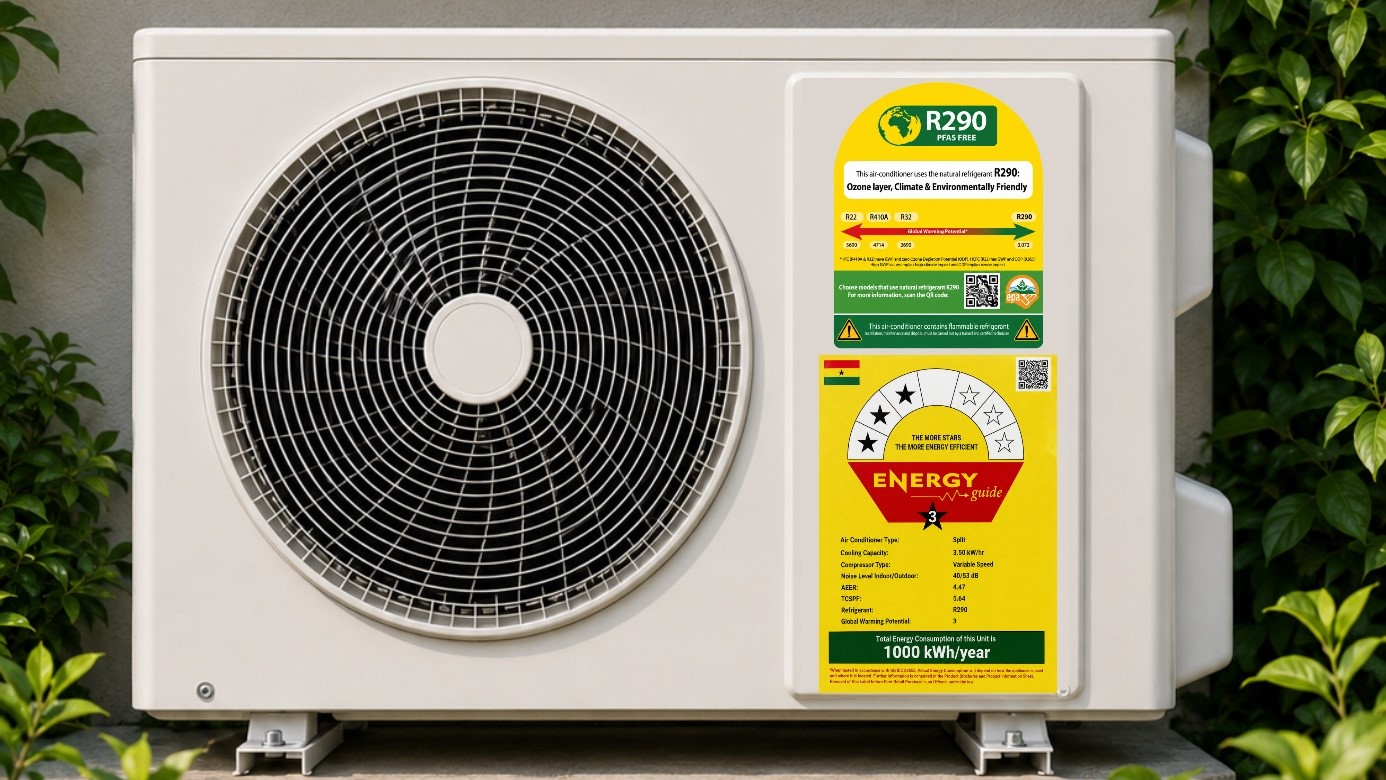
Now, one of such energy-efficient and lower-emission cooling technologies is the R290 split-inverter AC. R290 is a natural refrigerant and is used in a new generation of energy-efficient ACs. Unlike many conventional refrigerants, R290 has an ultralow Global Warming Potential (GWP) of 0.07, meaning it contributes almost zero to global warming if leaked into the atmosphere. R290 does not damage the ozone layer and does not contain PFAS, thus has no negative impact on the environment or human health. Therefore, R290 ACs come with an eco-refrigerant label of EPA. Beyond its environmental benefits, R290 systems are also known for their high energy efficiency, which can help reduce electricity consumption and lower operating costs for households and businesses over time.
The introduction of R290 ACs in Ghana forms part of broader efforts under the Green Cooling Programme, an initiative funded by the Swiss Klik Foundation, implemented by the EPA and GIZ. The programme aims to support Ghana’s transition toward more climate and environmentally friendly and energy-efficient split ACs, while strengthening technicians’ capacity and promoting responsible end-of-life AC refrigerant management.
As part of the initiative, a financial incentive of minimum, GH¢ 1100 per R290 AC unit has been introduced to reduce the upfront price of R290 units, making them more affordable. Consumers are getting a R290 inverter AC at cheaper price, just as the conventional split ACs on the market now. Again, a nationwide technician training programme is ensuring that those installing and maintaining these units are properly trained and certified. And finally, a formal system is being developed to ensure that old ACs are disposed of properly, with harmful refrigerants safely recovered instead of being released into the atmosphere.
Currently, the R290 split-inverter ACs are available in showrooms across Ghana through importers who have partnered with the Programme. These include Hisense, Midea (Electroland), GREE (Unique-Home-Appliances), and in the near future, also Haier (Electromat/Somotex).
As Ghana is a signatory to the Kigali Amendment and the Montreal Protocol, a binding international commitment to phase out high-global-warming refrigerants over time. The R290 split-inverter AC is one way the commitment becomes real. Not as a government document, but as an air conditioner on your wall, cooling your room, reducing your energy bill, and at the same time protecting the environment and climate. Sector experts say the transition to alternative cooling technologies could become increasingly important as temperatures rise and demand for air conditioning continues to grow across urban areas.
By:
Hilda Aku Asiedu
Climate Communications and Development Professional.